
Not everyone in the scientific community accepted the idea of high intelligence of bees. Critics argued that such behaviour might still be nothing more than a complex learned response shaped by the insect’s way of life. It might go beyond a simple reflex but still fall short of true thought.
Scientific experiments show that bees can learn what might be called a rule of relationship. If you offer a bee two identical shapes of different size, for example two circles, it will usually prefer the larger one. That makes sense. In nature, larger flowers often hold more nectar. So, from the bee’s point of view, bigger is often better.
But this preference can be reversed. If the smaller figure is paired with a reward and the larger one with salt solution, the bee learns to choose the smaller shape instead.
Bees are also able to notice not just single signals, but combinations of signals. One of the most difficult tasks is recognising a three-part colour combination. At this point, we begin to move very close to the question of insect intelligence.
By intellectual, or cognitive, abilities, we mean the ability to grasp not just one specific signal, but the logic of a situation, the rule that leads to success. One of the first scientists to study the intellectual abilities of bees seriously was Professor G. A. Mazokhin-Porshnyakov. Some of his most striking experiments showed that bees can form general ideas from visual objects.
In multi-stage training, bees were taught broad concepts such as triangle and quadrilateral. First, a bee was trained, by the method used by von Frisch, to tell one triangle from one quadrilateral. Then, at the next stage, the same bee was shown a new pair: again a triangle and a quadrilateral, but now of different size and with different proportions. Then the shapes were changed once more in a different way (steep triangle and trapezium), but one feature remained the same: the number of corners.
At the start of each new stage, the researchers held what they called an exam. In other words, they removed the reward from the test shapes, so that the bee could not simply follow a smell or some accidental detail connected with the food.
As expected, at the start of the second stage the bees chose randomly. Their earlier experience was not yet enough to reveal the hidden rule. But after training on the second pair, the bees were shown a third pair of new shapes. Now something interesting happened: the bees already showed a noticeable preference for the figure with the same number of angles as the one they had previously been trained to choose. By the fourth stage, with yet another new pair of figures, this preference had become very clear.
In other words, bees can behave as if they are able to count corners.
The list of tasks that bees have solved successfully is surprisingly impressive and this was not an isolated result. In later multi-stage experiments led by Professor Vladimir Kartsev, bees learned to judge the number of spots on a card, up to three, to distinguish two-coloured figures from single-coloured ones regardless of exact shape or colour combination, and to solve a range of other abstract tasks.
Know someone who needs to hear this? Share it with them.
IIt’s a risky gamble, but it shows something extraordinary: even in the smallest of creatures, courtship is not only about strength, but about strategy, timing, and sometimes… a well-executed lie.
Each deception is a contract with reality: fool or be fooled, lie or die. Let’s be honest: nature is a liar. A brilliant, shameless, unapologetic liar. And deception in nature isn’t just a trick - it’s a weapon, a love letter, and sometimes even a joke. If you look closely enough, you’ll see that almost every living thing cheats in one way or another. Welcome to the anatomy of the natural lie.
Deception works through channels - like sound, smell, or sight. Sometimes it’s one channel, sometimes it’s a whole orchestra of lies played together. Let’s break down the main flavours.
Tricking Eyes: Optical Camouflage.
Imagine walking through snowy woods. Suddenly - a hare leaps out in front of you. White as snow in winter, brown as earth in summer. It’s a shape-shifter, switching coats to melt into the background. The snowshoe hare doesn’t just hide - it rewrites itself into the environment.
Cuttlefish take this to the next level: they don’t just change colour, they change texture. Smooth like sand, bumpy like rock. They are living Photoshop filters, turning their whole body into a lie that fools even the smartest predators.
What If Everything We Believe About “Natural Truth” Is False?
The story of the lying spider is more than just a curious tale from biology. It’s a reminder that in nature, truth is not always what it seems - and survival often depends on bending reality.
For millions of years, male spiders faced a life-or-death dilemma: how to approach a female who is bigger, stronger, and sometimes cannibalistic. The honest strategy was clear - bring her real food, a nutritious fly or another insect, and she will be too occupied to attack. But then came the twist. Silk wrapping delayed the discovery of what’s inside, buying the male extra time. And finally, deception itself became a strategy of wrapping worthless items in silk and presenting them as a precious gift. By the time the female realises she’s been tricked, the male has already achieved his goal and slipped away.
Let’s not forget the masters of illusion - stick insects. They don’t just look like twigs, they sway in the wind like twigs. Optical deception paired with performance art. Some species of this insect evolved to imitate twigs, others to look exactly like leaves. Their disguise goes so deep that in evolution they’ve lost paired appendages - because sticking out ruins the illusion. Yet can any of them suddenly switch strategies? That’s the limit: their lies are written into their bodies.
And false visual signals? Classic move. The fangblenny fish pretends to be a toxic species - just to scare off predators. It’s harmless, but it knows how to dress dangerously.
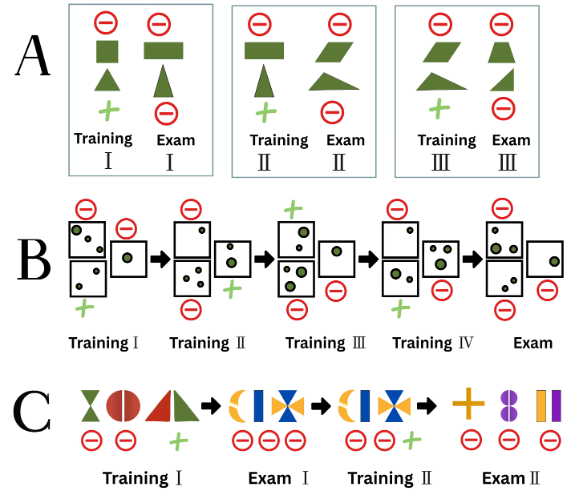
Diagram of experiments showing how bees can use abstract ideas such as number, angles, and the difference between a single-colour and a two-colour pattern, regardless of which colours are used.:
A, discrimination between triangles and quadrilaterals; B, discrimination of the number of objects; C, generalisation by the feature of “two-colouredness”; “+”, shapes containing a reward; “−”, shapes without a reward.
If you enjoy exploring the hidden strategies of nature, subscribe to receive new posts directly in your inbox. A free subscription gives you access to regular essays on how living systems solve problems through design, behaviour, and information strategies. From deceptive orchids and negotiating wolves to the deeper laws that shape life, each post reveals how nature thinks and operates.
I would be curious to know what that was for you.
They can distinguish cards with one, two, or three spots regardless of the size of the spots or where they are placed, a kind of counting to three. They can choose a two-coloured figure from among one-coloured ones, regardless of the figure’s size, shape, or the exact colours used. They can also choose figures made from chains of outlined circles by following a rule such as the black marker is at the edge of the chain.
So a bee is not just a tiny creature chasing sweetness. It can learn smells, colours, directions, size relationships, combinations of colours, and even abstract visual rules. For an insect with such a small brain, that is a rather large achievement.
In another experiment, the reward moved back and forth between two coloured landing spots, one pinkish and one orange. Gradually the bees noticed that the food followed a regular alternation. They began to land confidently first on one circle, then on the other, according to the pattern.
This is especially striking because instinct alone should have driven them back to the place where they had last found abundant food. But the bee did not merely repeat the last successful action. She detected a rule!
What matters in all these experiments is simple. The bee was not reacting only to one fixed picture. She was responding to a more general feature that remained the same when the details changed.
That is already very close to what we call genuine cognitive activity. In such cases, the animal is not simply storing one stimulus and one response. It is extracting a rule. Not a single signal, but an abstract relation. Not just a habit, but a small piece of knowledge.
For a creature with such a tiny brain, this is a remarkable conclusion.
It suggests that bees are capable not only of training in the ordinary sense, where repeated reward builds a conditioned reflex, but also of forming simple logical chains. Perhaps a large brain is not the only route to intelligence. Sometimes another thing is enough: the need to solve real problems every day, quickly, accurately, and with minimal waste of effort.
More than instinct
A bumblebee does not experience the world as something simple or automatic, nor does it react only on colour and smell. The bee world is a structured world. A world of light mosaics and solar angles. A world of ultraviolet signs and polarised sky. A world of moving patterns, remembered landmarks, changing rules, learning and taking the decisions.
The bumblebee does not merely react to that world. She reads it in her own way, stores what matters, ignores what does not, and uses that knowledge to move through a giant landscape with astonishing skill. What is striking is not that bees think exactly like mammals, but that their behaviour begins to resemble mammalian cognition in several important ways.
First, bees do not respond only to simple signals. Like mammals, they can learn rules. They can distinguish right from left, larger from smaller, and even general categories such as triangle versus quadrilateral. That means they are not just memorising one picture. They are extracting something more abstract from experience.
Second, bees can generalise. A mammal that has learned a rule can often apply it to a new situation, and bees seem able to do the same. When they were shown new shapes, sizes, or arrangements, they could still use what they had learned before. This is a very mammal-like feature of cognition.
Third, bees show something close to flexible problem-solving. They can use smell, colour, spatial position, and visual structure together, depending on the task. Mammals also combine different kinds of information rather than relying on one fixed cue.
Fourth, bees appear able to build a kind of internal model of the world. Their navigation, recognition of three-dimensional structure, and ability to understand relationships between objects all suggest that they do not live in a world of isolated signals. In this respect, they again resemble mammals, which also interpret space as a structured environment rather than a set of disconnected sensations.
So the main conclusion is this: the cognitive abilities of bees resemble those of mammals not in scale, but in principle. Their brains are tiny, but they can still learn abstract rules, generalise, combine different kinds of information, and act as if they understand something about the logic of the situation. In other words, a bee does not think like a miniature mammal, but it can solve problems in ways that are surprisingly mammal-like.
Do Bees Know Left from Right?
One of these is the direction of a turn. Can a bee tell “right” from “left” in relation to its own body, rather than just memorising landmarks along the route?
New here? Welcome. Join to catch every post in this series.
